Project Background
Marakayar Apartments, located in Nungambakkam, Chennai, is a residential community comprising eight independent houses and one apartment block. The property operates with a shared electricity connection that serves common-service requirements along with individual household consumption.
As electricity charges increased, the combined EB consumption became a significant recurring expense for the residents. Before the solar installation, the property faced a monthly EB bill of approximately ₹80,696. With multiple households and common services contributing to overall consumption, the residents sought a reliable, long-term solution to reduce their dependence on conventional grid electricity.
The requirement was not simply to install a standard residential solar system. The solution needed to accommodate the property’s combined electricity requirements while making effective use of the available rooftop area, planned as an integrated system capable of supporting shared electrical requirements across multiple households and common-service loads.
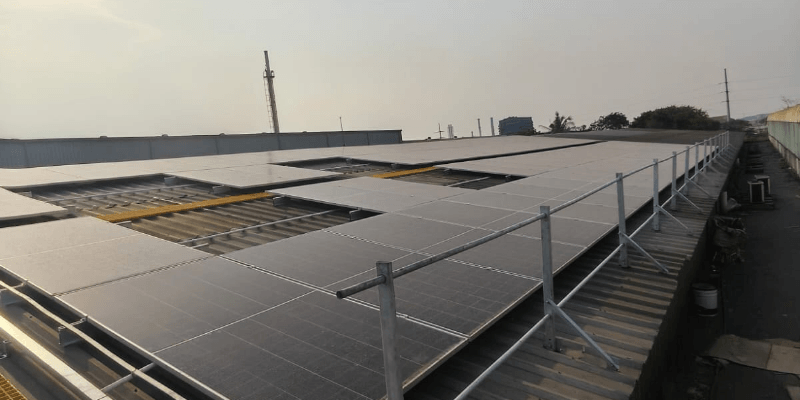
Based on this requirement, Maruthi Power Control Systems designed and installed a rooftop On-Grid solar power system using a Growatt inverter, mounted on the property’s elevated rooftop using a hot-dip-galvanized structure. The complete turnkey installation – mounting structure, panel installation, electrical wiring and grid synchronisation – was completed within 10 days and commissioned in March 2026.
Challenges
- High recurring electricity expense: the combined EB bill for eight houses, one apartment block, and common services had reached approximately ₹80,696 per month.
- Shared consumption model: the system had to address combined common-service and individual household loads, unlike a conventional single-house rooftop installation.
- Limited rooftop space: the elevated rooftop required careful planning to accommodate the panels and mounting structure effectively.
- Active residential environment: installation activities had to be coordinated to minimise inconvenience to residents living on the property throughout the project.
- Tight installation timeline: mounting, panel installation, wiring, and grid synchronisation all had to be completed efficiently without compromising quality.
How Maruthi Power Control Systems Approached It
The team began by understanding the customer’s electricity requirement and the drivers behind the high monthly EB expense, factoring in the combined nature of consumption across eight houses, an apartment block, and common services.
The available rooftop was assessed to determine a suitable arrangement for the panels and mounting structure; a hot-dip-galvanized structure was selected to suit the elevated-rooftop installation.
The solar array was planned as an integrated installation to support both common-service and individual household consumption, making effective use of available rooftop area while keeping execution organised.
The project involved installing 74 solar panels rated at 600 W each, together with a Growatt On-Grid inverter and the necessary mounting and electrical infrastructure. Execution was carefully sequenced – mounting, panel installation, wiring, and grid synchronisation – while the property remained an active residential community.
With focused coordination, the complete installation was finished within 10 days, and the system was synchronised with the EB grid and commissioned in March 2026.
Solution
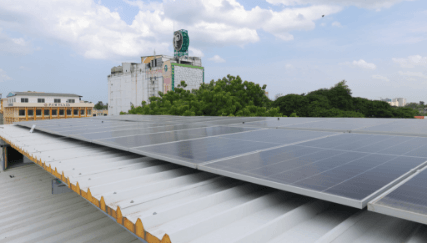
Maruthi Power Control Systems designed and installed a 50 kW rooftop On-Grid solar power system for Marakayar Apartments in Nungambakkam, Chennai. The installation consists of 74 solar panels rated at 600 W each, connected to a Growatt On-Grid inverter, and mounted on the elevated rooftop using a hot-dip-galvanized structure suited to the property’s configuration.
As an On-Grid solar system, the plant is connected to the EB grid and designed to offset a major portion of the property’s electricity requirement through solar generation, supporting both common-service and individual residential loads. The system is estimated to generate approximately 68,000 units of electricity annually.
The reported monthly EB bill fell from ₹80,696 before installation to approximately ₹17,000 after installation – a reduction of about ₹63,696, or roughly 79%. This demonstrates the significant impact the solar installation has had on the property’s recurring electricity expense, allowing residents to reduce dependence on conventional EB power while continuing normal residential activities.
Beyond the immediate cost savings, the project gives the community a long-term renewable energy solution – turning available rooftop space into a source of clean, self-generated electricity rather than treating the high EB bill as an unavoidable recurring cost.